Marrakech’s Main Square as a Center of Culinary Tourism
Marrakech’s Main Square as a Center of Culinary Tourism

Marrakech is widely recognized as the primary tourism hub of Morocco, with visitor movement shaped by a clear urban division. The city is structured around two distinct areas that influence how travelers experience it. The historical core, known as the Medina, functions as the traditional center of daily life, commerce, and visitor activity. In contrast, the newer European-style district, referred to as Gueliz or Ville Nouvelle, represents the modern extension of the city. Tourism activity is closely linked to the Medina, where heritage spaces, markets, and food traditions are concentrated, making it the focal point for most short-term visitors.
Eating in Djemaa El-Fna as a Tourist Experience
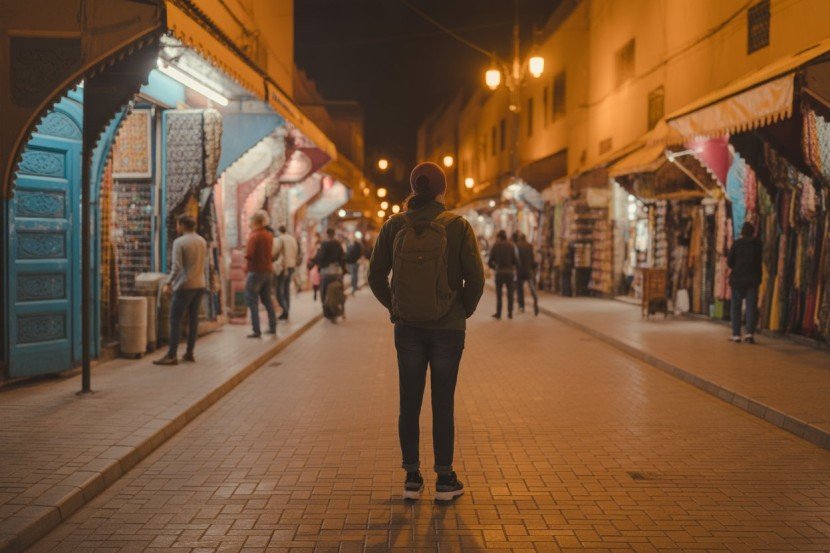
Food tourism in Marrakech is strongly associated with Djemaa El-Fna, a central square that transforms each evening into a large open-air dining area. At night, rows of licensed food stalls are assembled under white tents, forming a structured but informal eating environment. These stalls typically present menus in multiple languages, including French, Arabic, and English, reflecting the high volume of international tourists. Common offerings across the square include tajine, couscous, grilled skewers, and various soups, while some stalls specialize in offal-based dishes, egg-filled bread, or distinct tajine preparations.
Tourism patterns have influenced how these stalls operate, particularly through the use of staff positioned to attract customers. While these individuals are present near many stalls, their approach varies, and travelers often rely on brief refusals to disengage. Despite the tourist-facing appearance of the square, the food infrastructure itself predates modern mass tourism, and the stalls remain an established part of the city’s everyday food culture.
Tourism, Food Spaces, and Visitor Movement
For tourists navigating Marrakech, public food spaces function as transitional zones where travel routines intersect with local patterns of consumption. Large squares such as Djemaa El-Fna serve as gathering points that concentrate visitor activity while also maintaining continuous use by residents. This overlap shapes how tourism unfolds, with eating becoming both a practical necessity and a structured part of the travel experience. The physical layout of the square, combined with the nightly setup of food stalls, channels visitor movement into predictable paths, reinforcing its role as a central node in the city’s tourism economy.
How Travelers Adapt to Local Dining Environments
Travelers in Marrakech often adjust their dining habits to match the rhythm of the city rather than seeking fixed restaurant settings. Open-air stalls, shared seating, and visible food preparation create an environment that differs from enclosed dining spaces familiar to many visitors. Over time, repeated exposure encourages tourists to observe local choices, including stall selection and ordering patterns. This gradual adaptation allows visitors to participate in established routines without requiring formal guidance, reinforcing the square’s function as an accessible entry point into local food culture.
Core Food Facts and Pricing at Djemaa El-Fna
All food stalls operating in Djemaa El-Fna are licensed and subject to government oversight, a system reinforced by the square’s popularity with tourists. Pricing across the stalls covers a wide range, depending on portion size and meal structure. Simple items such as bread filled with grilled sausages or a bowl of harira soup are available at lower price points, while complete meals consisting of salad, bread, a starter, a main dish, and tea are priced higher. Menus display prices, which reduces the likelihood of incorrect charges, although additional items may be served without being requested and later included in the bill.
Local dining patterns differ slightly from tourist-focused stalls. Residents are more frequently observed at simpler, lower-cost stalls that do not employ customer greeters and that serve items such as snails, sheep head, lentils, and beans. These foods are part of the long-standing culinary offering of the square rather than recent additions driven by tourism demand.
Tea, Morning Food, and Drink Practices
Tea consumption forms a visible part of the food landscape at Djemaa El-Fna. Along the front of the food stalls, dedicated tea sellers operate independently, offering spiced tea at a fixed price per glass. These beverages are commonly paired with small cakes prepared using similar spices. In the early morning hours, food activity continues near the covered section opposite the Koutoubia, where riifa is prepared by frying folded dough in pans. This item is consumed primarily during the morning period and represents a different phase of the square’s daily food cycle.
Street Drinks and Tourist Awareness
Beyond food stalls, street vendors in Marrakech sell fresh orange juice by the glass, with pricing determined by the type of orange used. Standard juice is sold at a lower price, while blood orange juice is priced higher, requiring clear confirmation before purchase. Payment is commonly completed before consumption to avoid pricing disputes. Hygiene practices vary among vendors, and the reuse of glasses has been identified as a potential cause of stomach discomfort for travelers, making awareness an important part of the tourist experience.
Image Source: AI
The post Marrakech’s Main Square as a Center of Culinary Tourism appeared first on Travel And Tour World.