Big Breaking in Aviation Sector: Beechcraft 200 Aircraft, Flying over Colorado Makes Automated Emergency Landing Rocky Mountain Airport near Denver
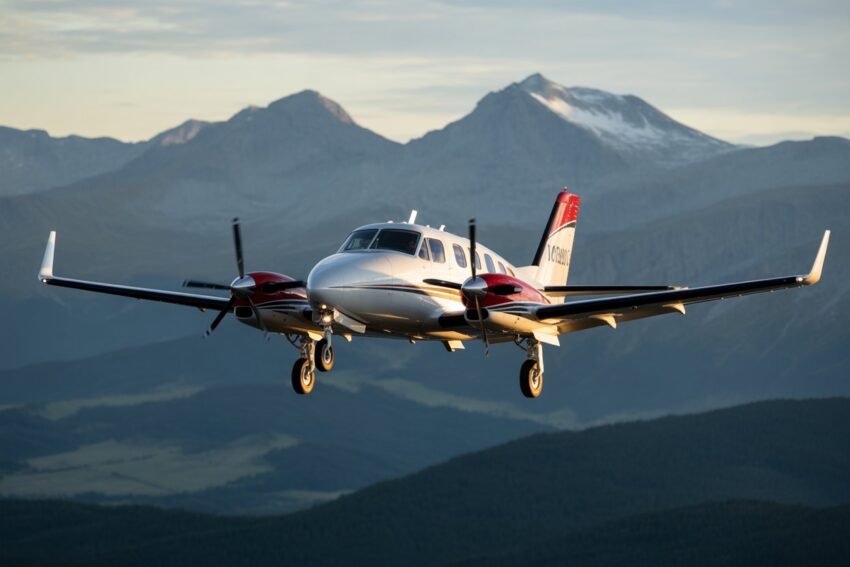

In a groundbreaking moment for aviation, a Beechcraft 200 aircraft, flying over Colorado, made a fully automated emergency landing at Rocky Mountain Airport, near Denver, after a critical cabin pressurization issue. This is the first time a fully automated emergency landing has been executed in real-world conditions, marking a monumental step forward in aviation technology. The Beechcraft 200, equipped with Garmin’s state-of-the-art Autoland system, was forced to activate the automated emergency landing system after the crew encountered an in-flight emergency.
The fully automated landing system took complete control of the aircraft, safely navigating it to the nearest runway at Rocky Mountain Airport. The crew, after experiencing the loss of cabin pressure, quickly donned oxygen masks but allowed the system to take over, ensuring the safe and efficient landing. The system’s decision-making process involved calculating the distance to the runway and sending updates to air traffic control.
This incredible incident demonstrates the life-saving potential of automated technology in aviation. The successful landing highlights how the future of air travel may increasingly rely on technology to handle critical situations, ensuring the safety of passengers and crew alike.
On December 20, 2025, aviation history was made when a Beechcraft 200 aircraft, flying over Colorado, became the site of the first-ever fully automated emergency landing in real-world conditions. This extraordinary event was driven by Garmin’s revolutionary Autoland system, a cutting-edge technology that took control of the aircraft during a critical cabin pressurization failure. In a scenario that once seemed like science fiction, Garmin’s Autoland system expertly guided the plane through the skies, communicating with air traffic control and safely landing it at Rocky Mountain Airport near Denver.
This unprecedented emergency landing marks a turning point in aviation safety, as the world witnessed the power of fully automated flight control in action. The technology, developed by Garmin, has been a game-changer in aviation, showcasing its ability to navigate and land an aircraft autonomously when human pilots are unable to act. Though no passengers were aboard the aircraft, this incident highlights the incredible potential of autonomous systems to prevent tragedies and ensure flight safety in critical situations.
In this article, we will dive into the details of this groundbreaking event, the capabilities of Garmin’s Autoland system, and what this means for the future of aviation. This milestone is not just a testament to technological innovation but also a glimpse into the future of air travel—where the machine might just be the best pilot in certain emergencies.
The Autoland Emergency Landing: A Life-Saving Technology in Action
The events of December 20 began like any other routine flight. A Beechcraft 200 aircraft, capable of carrying seven to nine passengers and two crew members, was making its way over Colorado. The aircraft, equipped with the latest technology, was cruising at a safe altitude, but things took a sharp turn when a sudden issue arose with the cabin pressurization. This malfunction triggered a response from Garmin’s Autoland system, designed to take control in emergency situations when the pilot is incapacitated or unable to handle the situation.
The Autoland system’s activation was not the result of a failure on the part of the crew, but rather a preemptive response to a life-threatening scenario. Upon detecting the drop in cabin pressure, the system immediately took over the aircraft, managing all aspects of the flight, including navigation, communication with air traffic controllers, and ultimately, the landing.
At the heart of the system’s ability to manage the flight was its programming, which allowed it to evaluate the distance to the nearest runway, determine the feasibility of the landing, and engage in communication with air traffic control as if it were the pilot itself. “This is the first time Autoland has been used from start to finish in a real emergency situation,” a Garmin spokesperson confirmed, marking this incident as a historical moment in aviation.
Garmin’s Autoland System: Designed for Critical Situations
Garmin’s Autoland system is the result of years of technological development aimed at improving aviation safety. The system is specifically designed for critical situations, where the pilot is incapacitated or unable to manually control the aircraft. Unlike other automatic landing systems that assist in bad weather conditions or low visibility, Autoland is focused solely on emergency scenarios.
When activated, Autoland takes complete control of the aircraft, guiding it through a series of predetermined steps to ensure the safest possible landing. In the case of the Beechcraft 200, once the system took over, it evaluated the aircraft’s position, selected the best possible landing site, and initiated communication with air traffic control. This is a significant step forward in aviation, as it removes the human element entirely in times of critical failure, ensuring that the aircraft will land safely, even without direct pilot intervention.
The technology works by using advanced sensors and software that continuously monitor the aircraft’s environment. Upon detecting a critical malfunction—such as the cabin pressure issue that triggered the December 20 landing—the system calculates the best possible course of action, including selecting an appropriate airport and determining the required flight path. It then takes control of the aircraft’s flight systems and guides the plane to a safe landing, even without human input.
The Beechcraft 200 Emergency Landing: A Step into the Future of Aviation
The Beechcraft 200’s emergency landing was an unprecedented event. When the cabin pressurization issue arose, the flight crew acted quickly to don their oxygen masks and stabilize the situation as best as possible. However, the aircraft’s condition was deteriorating rapidly, and the pilots made the decision to allow the Autoland system to take over completely. With the crew’s assistance, the system was able to safely control the aircraft’s descent and land it at the nearest suitable airport: Rocky Mountain Airport, located just outside of Denver.
In total, the plane was 19 minutes from the runway at Eppley Airfield in Omaha, Nebraska, when the system took control. Once in the control of the Autoland system, the aircraft’s descent was smooth and controlled, with air traffic controllers following the system’s guidance. In a message that could have seemed like science fiction just a few years ago, the system relayed to the tower, “Automatic emergency landing, 19 minutes from runway 30R at KBJC.” This marked a turning point for aviation, as technology took over entirely in a situation that would have once been too unpredictable for automation to handle.
Pilots’ Role in the Emergency: Decision to Let the Autoland System Take Over
Despite the groundbreaking nature of the Autoland system, the pilots aboard the Beechcraft 200 were not passive passengers during the event. They made a conscious and deliberate decision to let the system take full control. While they were fully trained to handle such situations, the severity of the cabin pressurization issue meant that the best course of action was to allow the Autoland system to complete the landing.
The pilots’ decision to trust the system was a calculated one. They were prepared to intervene if any problems arose, but given the system’s design and functionality, they recognized that the machine was likely the best option for a successful landing. As Chris Townsley, CEO of Buffalo River Aviation, explained, “Although the system functioned exactly as expected, the pilots were ready to take back control if any problems arose.”
This move by the pilots underscores the importance of collaboration between human judgment and technological innovation in aviation. While the system is not designed to replace human pilots, it serves as a critical safety net in cases where human intervention may be too late or impossible.
The Symbolic Turning Point for Aviation Safety
The successful emergency landing of the Beechcraft 200 is symbolic of a new era in aviation safety. It represents a leap forward in the integration of automation and artificial intelligence in flight operations. Garmin’s Autoland system proves that, in certain critical situations, the best pilot may not be human, but rather a machine programmed to handle the situation with precision and efficiency.
The incident has far-reaching implications for the aviation industry. The technology used in the Beechcraft 200’s emergency landing could become a standard feature in commercial aircraft, potentially saving countless lives in future emergency scenarios. As automation in aviation continues to evolve, it’s clear that systems like Garmin’s Autoland will play an increasingly significant role in ensuring the safety of passengers and crew members alike.
The Future of Aviation: Embracing Automation and Autonomy
Looking ahead, the aviation industry will likely see more advancements in autonomous systems that complement human pilots rather than replace them. Technologies like Garmin’s Autoland have already demonstrated their effectiveness in critical situations, and the next logical step is to expand their use across commercial fleets. This will require a shift in how the industry views the role of pilots and the integration of technology into aviation operations.
Garmin’s Autoland is just the beginning. As autonomous technology advances, we can expect more systems like this to emerge, further improving aviation safety and efficiency. The key takeaway from this incident is that, while pilots remain integral to flight safety, technology can be a crucial backup in emergencies. This shift towards greater automation in aviation represents a brighter, safer future for air travel.
The post Big Breaking in Aviation Sector: Beechcraft 200 Aircraft, Flying over Colorado Makes Automated Emergency Landing Rocky Mountain Airport near Denver appeared first on Travel And Tour World.