Switzerland Overhauls Corporate Travel as Bern Audits MICE Waste and Alpine Coolcations Surge by 14%
Switzerland Overhauls Corporate Travel as Bern Audits MICE Waste and Alpine Coolcations Surge by 14% 
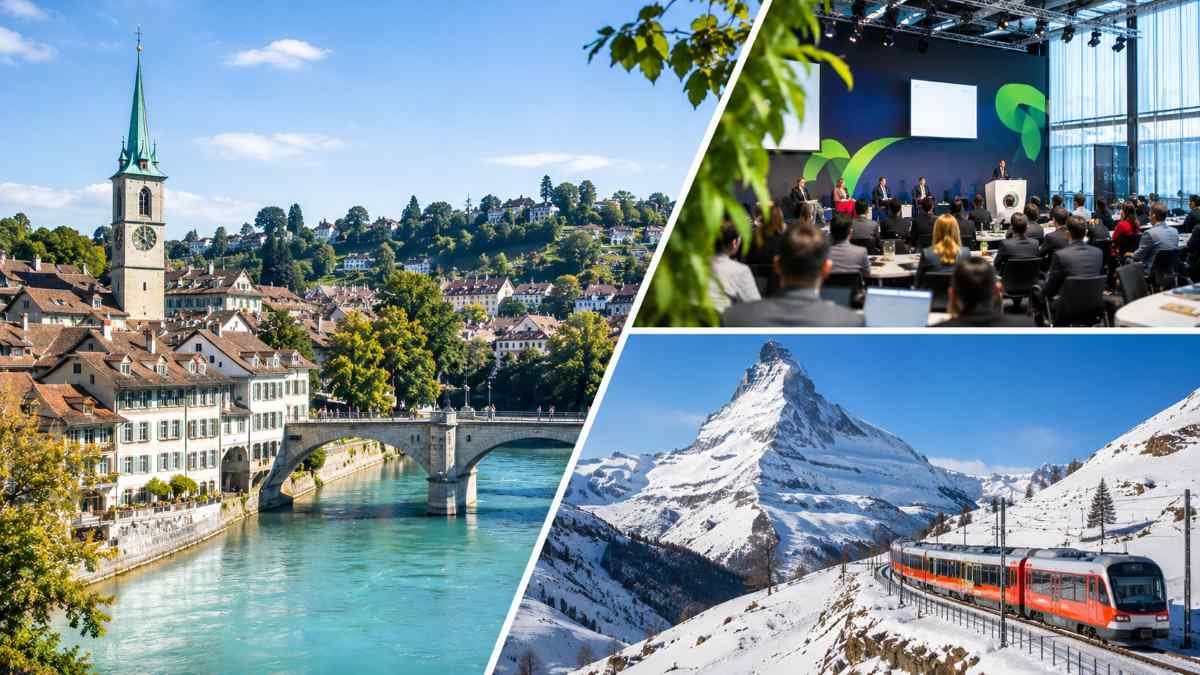
Bern is investing to ensure that it continues to be the choice for international conferences, professional events and sustainable business events. The combination of historic city centre and key convention spaces, a comprehensive and accessible public transport system, and proximity to the Swiss Alps all position Bern as an important destination for meetings, incentives, conferences and exhibitions (MICE). In addition to a firm sustainability agenda already in place for convention business and managed through Bern Welcome and the Bern Convention Bureau, the city has a range of initiatives around paperless event registration, virtual conference apps, responsible food procurement, and environmentally conscious event management. Bern has also earned the Energy City Gold label, a broader sustainability accreditation, and a number of the city’s hotels and event venues are committed to working with the Swiss tourism industry programme Swisstainable, designed to help tourism companies reduce their impact and create positive change. The Bern Convention Bureau also offers support to international event organisers, as part of the city’s Bern Urban and Business tourism network. For international conventions of more than 300 delegates, the SBB Congress Ticket offers up to a 50% discount for eligible return train travel on Swiss routes between the Swiss border or airport and Bern. However, the apparent introduction of mandatory automated net-zero auditing for conventions of more than 1,500 delegates cannot be confirmed. Bern’s current sustainability policies should not be represented as a new mandatory carbon offset rule.
Switzerland Introduces Digital Biometric Border Management
Switzerland has strengthened its international border management through participation in the European Union’s Entry/Exit System (EES), which became fully operational across participating Schengen external border crossings on 10 April 2026.
The system records travel-document information, entry and exit dates, facial images and fingerprints for eligible non-EU nationals travelling to the Schengen Area for short stays.
As a Schengen-associated country, Switzerland participates in the system alongside other European countries. Its implementation is intended to modernise border administration, improve identity verification and strengthen the monitoring of authorised stays.
For international business travellers, the system is relevant when entering or leaving the Schengen Area through Swiss airports, seaports and external land-border crossings.
An important distinction is that EES does not introduce routine biometric border registration for EU citizens travelling into Switzerland. Nor does it establish a new digital identity requirement across every international railway connection.
Switzerland is also preparing for further interoperability between European security and border information systems, with full implementation scheduled for 2028.
These developments form part of Europe’s wider digital border management programme.
Swiss Banks and Corporate Travel Rewards
Switzerland’s financial services industry offers international businesses access to corporate payment products, travel insurance and airline loyalty programmes.
These services are relevant to companies managing employee travel, accommodation bookings, conference expenditure and international flight reservations.
Airline-linked payment cards can provide benefits such as reward miles, travel-related insurance and selected airport services, depending on the issuing bank and card conditions.
For corporate travellers, these products can simplify expense management while allowing eligible purchases to contribute towards travel rewards.
However, the supplied announcement concerning new five-times mileage multipliers on Eurasian flight routes and green-certified aviation corridors could not be independently confirmed.
No verified announcement from a major Swiss banking institution establishes this particular reward structure as a newly activated national corporate travel incentive.
Switzerland’s Alpine Coolcation Tourism Gains Attention
Switzerland’s Alpine destinations are attracting attention as travellers increasingly consider mountain holidays and cooler-weather experiences.
The coolcation trend refers to choosing destinations with relatively mild temperatures, natural landscapes and outdoor activities instead of travelling exclusively to hotter holiday regions.
Swiss destinations such as Interlaken, Zermatt, Grindelwald, Davos and St. Moritz offer opportunities for mountain excursions, scenic railway journeys, hiking, wellness breaks and winter sports.
The latest official tourism figures demonstrate the strength of Switzerland’s accommodation sector. According to the Federal Statistical Office, Swiss hotels recorded 18.7 million overnight stays during the 2025/26 winter season, representing an increase of 1.1% compared with the previous winter.
Domestic visitors accounted for 9.5 million overnight stays, while international visitors generated 9.3 million.
Industry reporting has also identified growing interest in cooler holiday destinations. A survey of Swiss travel operators published by Travelnews reported that approximately 14% of DERTOUR Switzerland’s summer bookings were for coolcation destinations, with demand increasing by around 21% over five years.
However, these figures relate to summer travel and cannot substantiate the supplied claim of a 14% increase in winter itinerary reservations specifically for Swiss Alpine destinations.
Digital Expense Management and Swiss Tax Documentation
Switzerland already permits businesses to maintain accounting records and supporting documentation electronically, subject to established commercial and tax requirements.
Under the Swiss Code of Obligations, companies must preserve relevant accounting records for ten years. Electronic documents are acceptable when their authenticity, integrity, accessibility and readability can be maintained.
The country’s electronic invoicing infrastructure also allows businesses to receive structured digital invoices and transfer information directly into accounting systems.
These arrangements can help corporate travel departments manage hotel invoices, transport expenditure, conference payments and other business-related transactions.
However, electronic bookkeeping is not equivalent to a newly introduced requirement that all mobile business professionals must exclusively use automated receipt applications.
The supplied announcement concerning an extension of mandatory mobile expense-receipt processing could not be verified. Existing Swiss rules allow qualifying electronic and paper documentation, provided the applicable recordkeeping requirements are satisfied.
Conclusion
Switzerland set up the framework to make sustainable business tourism possible with eco-friendly conference planning, digital border controls, Alpine wayfaring experiences, and electronic accounting systems. Bern’s conferencing support structures gives real options for international visitors, and the Swiss Alpine region remains a popular destination for mountain lovers and cold holidaymakers. It is noteworthy how Switzerland’s long-established tourism and business infrastructure has enabled international travel, not merely announced it as government policy.
The post Switzerland Overhauls Corporate Travel as Bern Audits MICE Waste and Alpine Coolcations Surge by 14% appeared first on Travel And Tour World.