New York Airports Win Global Recognition for Airport AI Assistants as San José and Birmingham Report Rising Passenger Use
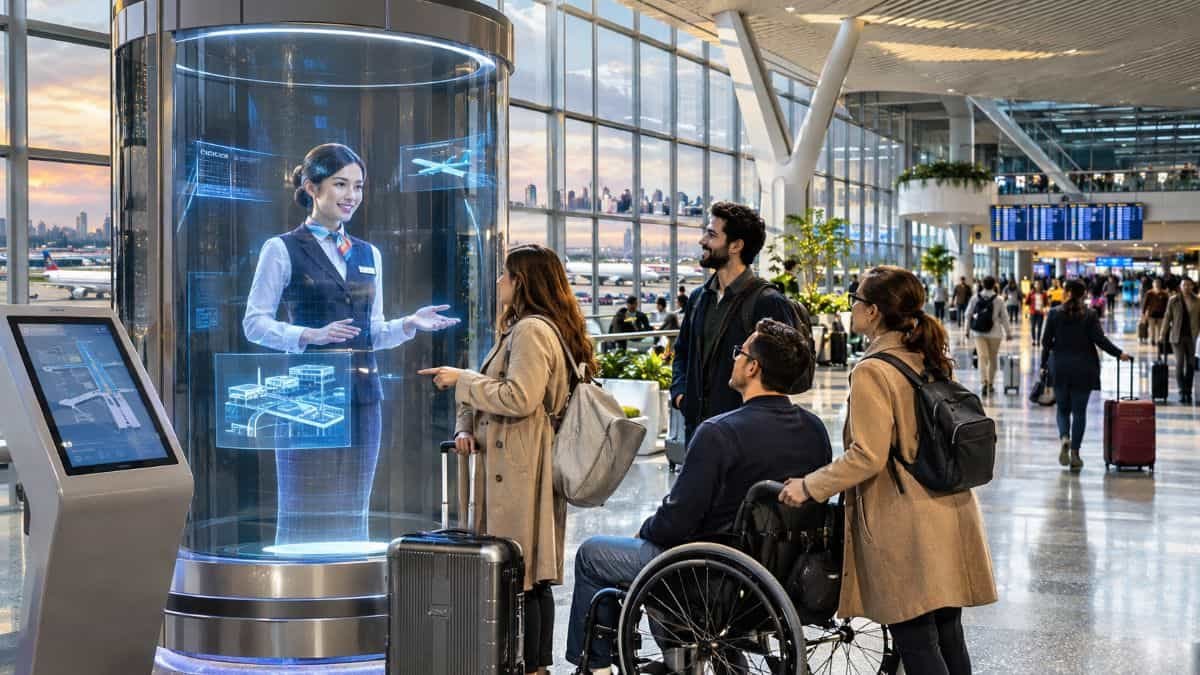

New York’s LaGuardia, JFK and Newark airports are gaining fresh recognition for their digital passenger services, as artificial intelligence reshapes airport navigation across the United States and Europe. On 30 October 2026, the Port Authority of New York and New Jersey announced that its four commercial airport websites had won the 2026 Airports Council International–North America award for best airport websites. The development follows the introduction of airport-specific AI assistants in July and LaGuardia’s holographic concierge Bridget in May. Meanwhile, San José reported more than 13,600 AI-assisted passenger conversations on 5 November. Boston and Birmingham are pursuing different approaches, revealing how airports are competing to deliver faster, more accessible and personalised travel assistance.
New York’s Latest Recognition Changes the Story
The significant November news is no longer simply LaGuardia’s holographic concierge. New York’s wider airport network has now received international industry recognition for a digital transformation that extends passenger assistance beyond physical terminal installations.
On 30 October, the Port Authority announced that the websites of JFK, Newark Liberty, LaGuardia and New York Stewart International Airport had won the 2026 Airports Council International–North America award for best airport websites.
The award recognises website design, communication, accessibility and navigation. ACI-NA assessed nearly 500 submissions across 20 award categories, making the recognition particularly relevant to the airport industry’s evolving digital customer experience.
The recognition follows a substantial redesign of all four airport websites. The platforms now feature airport-specific AI assistants developed and trained by Port Authority personnel familiar with individual airport operations.
Unlike generic chatbots, these assistants draw upon curated airport knowledge bases maintained by subject-matter experts. They also retrieve operational information, including flight details and security waiting times, alongside information from verified government and airport sources.
This development creates a stronger news angle for LaGuardia. Its earlier holographic experiment now sits within a broader regional strategy involving digital trip planning, live operational information and personalised passenger guidance.
New York’s Digital Airport Strategy Wins Industry Recognition
The important November development is not simply LaGuardia’s holographic concierge. New York’s wider airport network has received fresh international recognition for its digital passenger services, creating a stronger story about aviation’s changing customer experience.
On 30 October 2026, the Port Authority of New York and New Jersey announced that its four commercial airport websites had won the 2026 Airports Council International–North America (ACI-NA) award for Best Airport Websites. The recognition covers John F. Kennedy International (JFK), Newark Liberty International, LaGuardia and New York Stewart International airports.
The award followed major website redesigns introducing airport-specific artificial intelligence assistants. These platforms combine curated airport information with operational data, allowing travellers to obtain guidance before reaching the terminal. The development also places LaGuardia’s earlier holographic concierge, Bridget, within a much wider digital transformation programme.
ACI-NA assessed nearly 500 submissions across 20 award categories. Its website category considered design, communications, accessibility and navigation. This makes the recognition particularly relevant to airports competing to simplify passenger journeys through better information systems.
The Port Authority’s new platforms use separate AI assistants for individual airports. Each system draws upon a knowledge base developed and maintained by airport subject-matter experts. They also retrieve information from operational and verified external sources, including flight information, security waiting times and airport facilities.
Unlike generic travel chatbots, these assistants concentrate on the specific airport selected by the passenger. They can answer questions about restaurants, dietary options, prayer rooms, pet relief areas and accessibility facilities. Their responses can also adapt to information supplied during the conversation.
Port Authority Chairman Kevin O’Toole said the redesigned websites provide travellers with a more convenient way to obtain airport information. Executive Director Kathryn Garcia also highlighted the importance of reducing uncertainty for passengers unfamiliar with airport environments.
The initiative is particularly relevant ahead of major international travel periods. The Port Authority originally developed the websites with first-time visitors, including passengers arriving for 2026 World Cup matches and America250 events, in mind.
The November news angle is therefore a recognised expansion of digital airport services, not a new launch of Bridget. LaGuardia’s May installation remains an important earlier development, while the July website rollout and October award provide the newer story.
Four New York Airports Introduce Different Digital Tools
The Port Authority’s strategy extends across four airports serving different passenger markets. Each website provides airport-specific information rather than treating the metropolitan network as one interchangeable travel destination.
JFK serves extensive international and domestic traffic, while Newark Liberty operates as another major gateway for the New York metropolitan region. LaGuardia primarily serves domestic travellers, and Stewart offers an alternative for passengers travelling through the Hudson Valley.
Their redesigned digital platforms provide real-time travel information, security and customs waiting times, parking availability and concession details. JFK’s website also includes live departure information for AirTrain services.
The larger airports offer experience planners that can recommend facilities according to passenger requirements. For example, travellers can request information about accessible journeys or family-friendly airport facilities.
One particularly important feature concerns privacy. According to the Port Authority’s July announcement, the assistants do not process payments or reservations. The agency stated that they therefore do not save or store personally identifiable information through these interactions.
This distinction separates information assistance from transactional travel applications. Passengers can seek directions and operational information without treating the airport assistant as an airline booking platform.
| New York Airport | Digital Passenger Service | Practical Travel Application |
|---|---|---|
| JFK International | Airport-specific AI assistant and live AirTrain information | Flight enquiries, terminal facilities and onward airport transport |
| Newark Liberty | Dedicated AI assistant and airport information planner | Security information, parking and amenities |
| LaGuardia | AI website assistant alongside holographic concierge Bridget | Terminal guidance and passenger information |
| New York Stewart | Dedicated airport website assistant | Airport-specific travel planning and facilities |
The Port Authority’s digital programme also complements substantial physical infrastructure investment. Its October announcement identified a $19 billion transformation programme at JFK, involving new terminals, renovated facilities and redesigned road access.
LaGuardia’s redevelopment, largely completed in 2022, has also received multiple industry distinctions. Terminal B previously won Skytrax recognition as the world’s best new airport terminal in 2023. The airport has continued building its reputation through passenger-service improvements.
These developments demonstrate an important commercial shift. Airport competition increasingly involves the entire passenger journey, including the information available before travellers reach check-in.
San José Produces the Latest Passenger Engagement Figures
While New York’s recognition centres on website design and integrated information, San José Mineta International Airport offers a different measure of progress: actual passenger interactions.
On 5 November 2026, Airports AI Alliance reported that San José’s AI-powered virtual assistants had handled more than 13,600 passenger conversations since their introduction earlier this year. The figures were disclosed by technology provider LiveX.
The company reported that the assistants resolved approximately 95% of questions and achieved an average user rating of 4.6 out of five. These are provider-reported results, not independently audited airport performance statistics.
San José initially introduced its AI Hosts during Super Bowl LX, helping visitors navigate the airport during a major international sporting event. The assistants subsequently remained available in Terminal A and near Gate 24 in Terminal B.
Passengers can ask questions verbally, access interactive maps and transfer navigation routes to their smartphones through QR codes. The system does not require passengers to download a dedicated application before using its assistance.
The deployment also provides an interesting lesson about positioning. LiveX reported that the assistant near Gate 24 attracted approximately twice the engagement of another installation along a busy walkway.
According to Jia Li, Co-founder, President and Chief AI Officer at LiveX, passenger sessions increased by 74% during the 2026 World Cup compared with the preceding period.
Li explained the importance of practical accessibility in a statement published on 5 November 2026:
“The biggest lesson is that conversation has to work in the real world, not just in a quiet demo room.”
This observation highlights a challenge for airport technology developers. A system might perform effectively during a demonstration but struggle with announcements, crowds and competing conversations.
San José’s technology incorporates noise-management capabilities to isolate passenger voices. It also uses airport-controlled information and retrieval systems to generate relevant answers.
The company has introduced additional interactive 3D navigation capabilities and is preparing Portal, a smaller device designed for installation on walls or stands. This could extend digital assistance to more terminal locations.
| San José AI Performance Indicator | Reported Result |
|---|---|
| Passenger conversations | More than 13,600 |
| Reported question resolution | Approximately 95% |
| Average user rating | 4.6/5 |
| Passenger-session increase during World Cup | 74% |
| Engagement near Gate 24 compared with a busy walkway | Approximately 2 times |
The comparison with New York is particularly revealing. New York’s approach concentrates on connecting airport information across digital channels, whereas San José highlights physical interaction and measured passenger engagement.
Boston Brings Holographic Assistance to More Travellers
Boston Logan International Airport provides another important comparison, particularly for LaGuardia’s earlier holographic initiative.
In September 2026, the Massachusetts Port Authority introduced Amelia, a life-sized AI avatar designed to assist passengers with terminal navigation. The deployment involves Proto Hologram and Holomedia AI.
Amelia combines natural conversational interaction with step-by-step directions and live mapping. Passengers can request information about departure gates, baggage collection, restaurants, shops and lounges.
One notable difference concerns language coverage. The Boston installation is reported to support up to 40 languages, considerably expanding the multilingual reach compared with Bridget’s initial English and Spanish capabilities.
The system also integrates TSA security waiting-time information, giving passengers access to operational details alongside directional guidance. It provides touchscreen interaction and can connect passengers with live customer-service assistance when necessary.
According to technology-provider reporting, Amelia covers approximately 400 airport locations, with an ambition to increase that number to 1,000. These figures describe the deployment’s stated mapping coverage, rather than independently verified navigation accuracy.
Massport Assistant Director of Media Relations Samantha Decker described the project’s purpose in September 2026:
“Our goal is to create a seamless, welcoming airport experience while complementing the work of our dedicated customer service team.”
The comparison with LaGuardia reveals how rapidly holographic assistance is developing. Bridget introduced the concept to LaGuardia passengers in May, while Boston subsequently demonstrated a broader language offering and integration with security information.
| Feature | LaGuardia – Bridget | Boston Logan – Amelia |
|---|---|---|
| Introduction | May 2026 | September 2026 |
| Technology | Holographic AI concierge | Life-sized holographic AI avatar |
| Languages | English and Spanish | Up to 40 reported languages |
| Navigation | Interactive directions and mapping | Step-by-step directions and live mapping |
| Additional information | Gates, restaurants, lounges and baggage claim | Facilities, baggage and TSA waiting times |
| Accessibility | High-contrast display, captions and wheelchair-accessible positioning | Touchscreen interaction and live-agent connection |
| Deployment scope | Terminal B | Airport-wide pilot across terminal locations |
The comparison should not be interpreted as a formal performance ranking. The airports have different deployment scopes, technical configurations and publicly available measurements.
Nevertheless, Boston’s introduction demonstrates that holographic assistance is moving beyond a single experimental installation. Airport operators are exploring more extensive deployments with greater language coverage and operational integrations.
Birmingham Demonstrates the Value of Continuous Passenger Support
The United Kingdom provides another valuable case study through Birmingham Airport’s BABS digital assistant. Its latest performance update, published on 15 October 2026, offers one of the clearest examples of how conversational technology can become an established airport service.
BABS, developed in partnership with Hello Lamp Post, completed its first year of operation with more than 220,000 customer interactions. Passengers exchanged over 780,000 messages through the platform during that period.
The assistant covers check-in, security, baggage procedures, parking, lounges and accessibility facilities. It also provides live travel information, including flight updates and security waiting times.
Unlike holographic installations, BABS concentrates on accessible digital conversations through dedicated airport touchscreens, QR codes and passengers’ own devices. This approach allows travellers to continue conversations beyond a single physical information point.
The airport says the service has saved employee time by handling routine enquiries. Staff can consequently concentrate on vulnerable passengers and travellers requiring more personal assistance.
Stuart Haseley-Nejrup, Head of Customer Strategy at Birmingham Airport, explained the operational benefit in the airport’s 15 October announcement:
“BABS helps people get the information they need quickly, while giving our colleagues more time to focus on the customers who need a more personal level of care.”
The airport is now exploring additional spoken-word functionality to improve accessibility for passengers who may find conventional text-based interactions difficult. It is also examining opportunities to extend the platform towards employee support and wider operational coordination.
BABS therefore offers a different lesson from the American holographic projects. Passenger assistance does not necessarily require a life-sized digital human. A well-integrated conversational platform can generate substantial engagement through simpler interfaces.
| Birmingham BABS Indicator | Reported Performance |
|---|---|
| Operating milestone | One year |
| Customer interactions | More than 220,000 |
| Messages exchanged | More than 780,000 |
| Service availability | 24 hours |
| Access channels | Touchscreens, QR codes and personal devices |
| Future development | Spoken-word accessibility and wider operational integration |
The reported 220,000 interactions are not directly comparable with San José’s 13,600 conversations. The reporting periods, definitions of an interaction and deployment arrangements differ.
Nevertheless, Birmingham’s figures demonstrate the potential scale of routine digital passenger support. They also suggest that airports can develop substantial usage without relying on prominent holographic installations.
Airport AI Investment Is Accelerating Worldwide
These individual projects form part of a wider aviation technology investment movement. Airports are increasingly exploring artificial intelligence to improve customer communication, passenger-flow management and operational coordination.
SITA’s 2025 Air Transport IT Insights provides useful industry-wide evidence. Its airport research found that 73% of airports planned to increase AI investment over the following two years.
The report also found that 57% of airports were already using AI in customer-service tools. Meanwhile, 56% identified core IT, telecommunications and networking infrastructure as their leading investment priority over the following 12 months.
| Airport Technology Indicator | SITA 2025 Finding |
|---|---|
| Airports planning higher AI investment | 73% |
| Airports using AI in customer-service tools | 57% |
| Airports prioritising core IT and telecommunications | 56% |
| Airports using AI in baggage applications | 17% |
| Airports using AI in retail applications | 18% |
The comparatively lower adoption in baggage and retail highlights an important industry challenge. Airports operate complex environments involving airlines, ground handlers, concessionaires, security agencies and technology providers.
Consequently, integrating AI into customer-facing applications can be easier than coordinating systems across multiple operational organisations.
SITA also explains how predictive AI can support passenger-flow management. Systems can anticipate queue formation at check-in, security, boarding, border control and baggage collection.
They can recommend earlier staffing adjustments, additional screening lanes or passenger rerouting before congestion intensifies. However, these capabilities require access to dependable operational information and integration with airport management systems.
Passenger-facing assistance and predictive airport management are two different technological developments. A holographic concierge can guide travellers, but it cannot independently open security lanes or guarantee shorter queues.
This distinction should guide how passengers and airport businesses evaluate future investments.
From Static Signs to Intelligent Passenger Navigation
Traditional airport information systems depend on signs, printed maps, information counters and electronic departure boards. These remain essential, but they cannot always answer individual questions or provide personalised directions.
Conversational systems introduce a more interactive method. Passengers can ask where a particular restaurant is located, whether an airport provides prayer facilities or how to reach a departure gate.
The next development involves connecting those answers with accurate indoor mapping and real-time information. San José’s QR-based navigation, Boston’s TSA integration and New York’s airport-specific knowledge bases demonstrate different elements of this emerging model.
The commercial opportunity extends beyond passenger convenience. Airports can use anonymised enquiry patterns to identify frequently requested services and recurring information gaps.
For example, repeated questions about security locations could indicate that signs need improvement. Frequent enquiries about accessible routes might reveal demand for clearer mobility information.
However, airports must establish appropriate privacy safeguards before using passenger interactions for wider analytics. They should also explain what information they collect, how long they retain it and whether third-party technology providers can access it.
New York’s July announcement offers one specific example of a privacy-conscious design. Its website assistants do not process purchases or reservations and were described as not storing personally identifiable information through those interactions.
Other deployments may follow different data arrangements. Travellers should therefore consult individual airport privacy policies rather than assume every AI service operates identically.
Accessibility Could Become a Competitive Advantage
One of the most important consequences of airport digitalisation concerns passengers who require additional assistance. Multilingual navigation, readable interfaces and personalised information can make unfamiliar terminals less intimidating.
Boston’s reported 40-language capability provides a significant contrast with Bridget’s initial bilingual service. Meanwhile, Birmingham is exploring spoken-word functionality, and New York’s airport experience planners can recommend accessible journeys according to passenger requirements.
These developments address different accessibility needs. Language support helps international visitors, while voice interaction may benefit passengers who struggle with text-heavy interfaces.
However, digital assistance cannot replace physical accessibility. Passengers using wheelchairs still need suitable lifts, accessible toilets, unobstructed routes and appropriately trained assistance personnel.
LaGuardia Terminal B already has a wider accessibility programme. It received Gold certification from the Rick Hansen Foundation Accessibility Certification programme in 2023. The terminal also participates in the Hidden Disabilities Sunflower programme and provides sensory bags through KultureCity.
The airport’s existing provisions demonstrate why AI should form part of a wider inclusion strategy. A digital assistant can explain where accessible facilities are located, but airport operators must ensure those facilities remain available and functional.
What Could Go Wrong With Airport AI?
Despite its potential, conversational technology introduces operational risks that airports cannot overlook.
Incorrect directions could become particularly problematic when terminals undergo construction or airlines change departure gates. Airport assistants need regularly updated maps and reliable information feeds.
Background noise presents another challenge. Boarding announcements, crowds and overlapping conversations can affect voice recognition, making conversational assistance less dependable.
Language accuracy also matters. Supporting dozens of languages does not automatically guarantee accurate translations of technical aviation instructions or emergency information.
Privacy requires equally careful attention. Systems connected to passenger locations, mobile devices or travel information must follow applicable data-protection requirements.
Most importantly, airports must retain human assistance for complicated situations. Disrupted connections, missed flights, medical emergencies and specialised accessibility requirements demand more than automated responses.
The strongest deployment model is therefore a combination of digital efficiency and human judgement. Technology should handle routine enquiries while employees remain available for passengers needing personal support.
What These Developments Mean for Travellers
For international passengers, the emerging technology could simplify airport navigation before departure and during connections. Travellers may increasingly obtain information about security waiting times, terminal facilities, accessible routes and onward transport through conversational interfaces.
However, passengers should understand the differences between individual services. Some assistants operate through airport websites, others use physical holographic installations, while platforms such as BABS combine touchscreens and personal devices.
Practical Travel Tips
- Check the official airport website before travelling to understand which digital assistants are available.
- Confirm departure gates through airline notifications and airport flight-information screens.
- Use airport AI assistants for directions, facilities and routine enquiries.
- Arrange wheelchair assistance and other specialist services directly with your airline.
- Check whether multilingual or voice-based assistance is available before relying on it.
- Contact airport employees when dealing with cancellations, medical requirements or complicated connections.
| Passenger Need | Most Useful Digital Development |
|---|---|
| Finding departure gates | Interactive indoor navigation |
| Understanding airport facilities | Conversational AI assistants |
| Overcoming language barriers | Multilingual digital concierges |
| Checking security information | Connected operational data |
| Planning accessible journeys | Personalised airport experience planners |
| Obtaining immediate human assistance | Live customer-service connections |
The Next Competition Will Be About Passenger Experience
The developments across New York, San José, Boston and Birmingham demonstrate that airport innovation is moving beyond isolated technological demonstrations. Operators are increasingly connecting conversational assistance with airport information, indoor mapping and accessibility services.
New York’s October industry recognition provides a fresh reason to examine LaGuardia’s earlier Bridget installation. San José’s November performance figures add another dimension, while Boston and Birmingham demonstrate how different interfaces can serve distinct passenger requirements.
The next challenge will involve proving measurable improvements. Airports must establish whether these systems reduce repetitive enquiries, improve passenger satisfaction and make information easier to access.
For travellers, the ultimate value will not depend on whether an assistant appears as a hologram or a touchscreen. It will depend on whether the information is accurate, accessible and available when needed. The future intelligent airport must make complex journeys simpler, not introduce another layer of digital confusion.
The post New York Airports Win Global Recognition for Airport AI Assistants as San José and Birmingham Report Rising Passenger Use appeared first on Travel And Tour World.